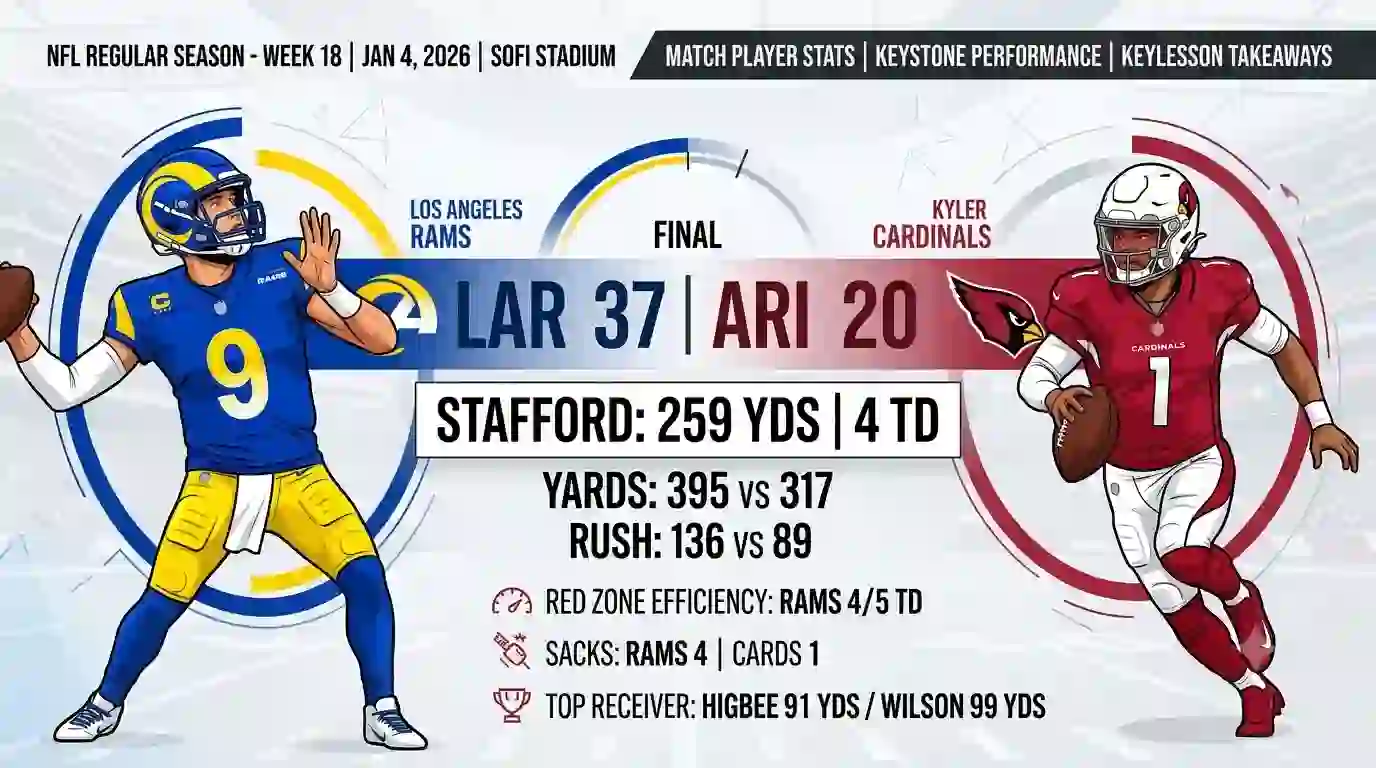
Finding a comprehensive breakdown of the arizona cardinals vs los angeles rams match player stats often leaves fans wading through cluttered box scores without understanding the tactical story behind the numbers. Superficial summaries fail to capture how individual execution dictated every drive. This deep statistical breakdown delivers exact player metrics, quarter-by-quarter momentum shifts, and analytical takeaways from this NFC West clash.
The Los Angeles Rams secured a dominant 37-20 victory over the Arizona Cardinals on January 4, 2026, at SoFi Stadium in front of 72,125 fans. The win capped off a 12-5 regular season for Los Angeles, locking up the No. 5 seed in the NFC postseason bracket. Head coach Sean McVay and general manager Les Snead celebrated their 100th combined victory behind a surgical offensive game plan.
Los Angeles controlled the tempo from the second quarter onward, utilizing methodical intermediate passing routes and red-zone efficiency. Arizona remained competitive through first-half field goals but could not keep pace once the Rams’ passing attack found its rhythm near the goal line.
Match Overview Table
| Information | Match Details |
| Event | NFL Regular Season (Week 18) |
| Game | Arizona Cardinals vs Los Angeles Rams |
| Date | January 4, 2026 |
| Venue | SoFi Stadium (Inglewood, CA) |
| Attendance | 72,125 |
| Winner | Los Angeles Rams |
| Final Score | 37 – 20 |
| Broadcast | FOX |
Core Match Statistics Overview
| Category | Los Angeles Rams | Arizona Cardinals |
| Total Offensive Yards | 395 | 317 |
| Passing Yards | 259 | 228 |
| Rushing Yards | 136 | 89 |
| First Downs | 24 | 17 |
| Third Down Efficiency | 7/13 (53.8%) | 4/11 (36.4%) |
| Turnovers Lost | 0 | 1 |
| Sacks Allowed | 2 | 4 |
| Time of Possession | 32:14 | 27:46 |
Matthew Stafford Passing Stats and Quarterback Production
- Matthew Stafford finished 25 of 40 for 259 yards, 4 touchdowns, and 0 interceptions, registering a 112.4 passer rating.
- Stafford averaged 6.5 yards per attempt, distributing all 4 touchdown passes inside the 20-yard line.
Red Zone Efficiency and Finishing Drives
- Los Angeles converted 4 of their 5 red-zone trips into touchdowns, capitalizing on tight-end mismatches.
- Arizona struggled inside the 20, settling for early field goals rather than six points.
Pressure Packages and Defensive Sack Totals
- The Rams’ front seven recorded 4 sacks and 6 quarterback hits, disrupting Arizona’s timing.
- Arizona managed 1 sack on Stafford while giving up consistent pressure on standard passing downs.
Period-by-Period Analysis
First Quarter
| Period | Arizona Cardinals | Los Angeles Rams |
| Q1 | 3 | 3 |
- Josaiah Stewart recorded a sack-fumble on Arizona’s opening drive, setting up Harrison Mevis for a 34-yard field goal.
- Arizona responded with an 8-minute drive ending in a 45-yard field goal from Chad Ryland.
- Both defenses limited big plays over the top, keeping second-down gains under 3 yards.
Second Quarter
| Period | Arizona Cardinals | Los Angeles Rams |
| Q2 | 3 | 13 |
- Harrison Mevis kicked a 42-yard field goal to put Los Angeles ahead 6-3 after a red-zone stall.
- Chad Ryland answered with a season-long 56-yard field goal to tie the game at 6-6.
- Stafford capped off a late two-minute drill with a 2-yard touchdown pass to Puka Nacua with 1:22 remaining in the half.
Third Quarter
| Period | Arizona Cardinals | Los Angeles Rams |
| Q3 | 14 | 7 |
- Jacoby Brissett threw a 19-yard touchdown strike to Michael Wilson to pull Arizona closer.
- Stafford connected with Tyler Higbee on an 18-yard seam route touchdown to re-establish control.
- Josiah Deguara caught a 7-yard touchdown pass for Arizona to keep the margin at six points going into the final quarter.
Fourth Quarter
| Period | Arizona Cardinals | Los Angeles Rams |
| Q4 | 0 | 14 |
- Colby Parkinson caught two touchdown passes (4 yards and 8 yards) in the fourth quarter to pull away.
- The Rams defense held Arizona to 38 total yards across their final three possessions.
- Kyren Williams and Blake Corum combined for 42 rushing yards on the final clock-killing drive.
Los Angeles Rams Player Statistics
| Player | Position | Passing | Rushing | Receiving | Touchdowns |
| Matthew Stafford | QB | 25/40, 259 YDS | 1 ATT, 3 YDS | — | 4 PASS TD |
| Kyren Williams | RB | — | 12 ATT, 60 YDS | 3 REC, 21 YDS | 0 |
| Blake Corum | RB | — | 13 ATT, 59 YDS | 1 REC, 10 YDS | 0 |
| Puka Nacua | WR | — | 2 ATT, 24 YDS | 10 REC, 76 YDS | 1 REC TD |
| Tyler Higbee | TE | — | — | 5 REC, 91 YDS | 1 REC TD |
| Colby Parkinson | TE | — | — | 4 REC, 36 YDS | 2 REC TD |
Impact Summaries:
- Matthew Stafford: Stafford surpassed Dan Marino on the NFL’s all-time passing touchdown list with a clinical four-touchdown performance.
- Puka Nacua: Nacua acted as the primary safety valve, catching 10 passes while drawing constant double coverage in underneath zones.
- Tyler Higbee: Higbee exploited linebackers over the middle, generating 91 yards on 5 catches in his return from injury.
- Desjuan Johnson: Johnson anchored the pass rush with 2.0 sacks and 4 quarterback hits.
Arizona Cardinals Player Statistics
| Player | Position | Passing | Rushing | Receiving | Touchdowns |
| Jacoby Brissett | QB | 31/48, 228 YDS | 3 ATT, 19 YDS | — | 2 PASS TD |
| Emari Demercado | RB | — | 2 ATT, 29 YDS | 1 REC, 28 YDS | 0 |
| Michael Carter | RB | — | 7 ATT, 18 YDS | 3 REC, 21 YDS | 0 |
| Michael Wilson | WR | — | — | 5 REC, 99 YDS | 1 REC TD |
| Trey McBride | TE | — | — | 7 REC, 65 YDS | 0 |
| Chad Ryland | K | — | — | — | 2 FG (56 LNG) |
Impact Summaries:
- Jacoby Brissett: Brissett fought through four sacks to throw two second-half touchdowns but averaged just 4.75 yards per attempt.
- Michael Wilson: Wilson provided Arizona’s biggest playmaking threat, recording 99 yards and a touchdown on 5 receptions.
- Trey McBride: McBride hauled in 7 catches to convert key short-yardage downs before Los Angeles adjusted late.
- Budda Baker: Baker led all defenders with 9 total tackles (7 solo) and 2 tackles for loss.
Statistical Leaders Summary Table
| Category | Los Angeles Rams | Arizona Cardinals |
| Leading Scorer | Colby Parkinson (12 PTS) | Chad Ryland (8 PTS) |
| Top Rusher | Kyren Williams (60 YDS) | Emari Demercado (29 YDS) |
| Top Receiver / Playmaker | Tyler Higbee (91 YDS) | Michael Wilson (99 YDS) |
| Leading Tackler / Defense | Jaylen McCollough (7 TKL) | Budda Baker (9 TKL) |
Analytical Breakdowns (“Why They Won / Why They Lost”)
Why Los Angeles Rams Won
Red Zone Target Distribution
Stafford spread his four red-zone scoring strikes across three tight ends and receivers, preventing Arizona from doubling Puka Nacua inside the 10-yard line.
| Target | Red Zone Receptions | Red Zone TDs |
| Colby Parkinson | 3 | 2 |
| Puka Nacua | 4 | 1 |
| Tyler Higbee | 2 | 1 |
Balanced Backfield Execution
The duo of Kyren Williams and Blake Corum maintained fresh legs throughout the game, combining for 119 rushing yards on 25 carries to keep third downs manageable.
| Running Back | Carries | Rushing Yards | Yards Per Carry |
| Kyren Williams | 12 | 60 | 5.0 |
| Blake Corum | 13 | 59 | 4.5 |
Why Arizona Cardinals Lost
Inability to Establish Running Game
Arizona generated only 89 rushing yards, forcing Jacoby Brissett into 48 passing attempts behind a struggling offensive line.
Pass Protection Failures on Third Down
The Cardinals permitted 4 sacks and 6 QB hits, with three sacks occurring on third-and-medium situations.
Historical Context & Advanced Insights
Season Series Breakdown
| Date | Matchup | Final Score | Winning Team |
| Dec 7, 2025 | Rams at Cardinals | 45 – 17 | Los Angeles Rams |
| Jan 4, 2026 | Cardinals at Rams | 37 – 20 | Los Angeles Rams |
Advanced Statistical Insights
Los Angeles recorded an Offensive EPA (Expected Points Added) per play of +0.22, driven by a 53.8% third-down conversion rate. Stafford’s average time to throw was 2.45 seconds, effectively neutralizing Arizona’s pass rush. Conversely, Arizona averaged -0.11 EPA per pass attempt when pressured, highlighting the difference in pocket management.
Game Implications & Key Lessons
What This Means for Los Angeles Rams
- Clinches the No. 5 seed in the NFC playoffs and momentum heading into wild-card weekend.
- Validates Tyler Higbee’s full integration back into the passing scheme.
- Reaches the 100-win milestone for the Sean McVay and Les Snead partnership.
What This Means for Arizona Cardinals
- Highlights offensive line protection as the top offseason priority.
- Confirms Michael Wilson’s growth into a legitimate perimeter threat.
- Emphasizes the need for defensive backfield depth to cover multi-tight end sets.
Key Lessons
- Tight end usage in the red zone remains one of the highest-percentage play calls in football.
- Balanced tailback rotations sustain fourth-quarter rushing efficiency.
- Field goals in place of red-zone touchdowns cannot defeat elite passing teams.
- Short, quick-release throws protect aging quarterbacks against blitz-heavy schemes.
- Winning the turnover battle directly correlates with fourth-quarter point differential.
SEO FAQ & Conclusion
Who won the Arizona Cardinals vs Los Angeles Rams game?
The Los Angeles Rams defeated the Arizona Cardinals 37-20 at SoFi Stadium.
What were Matthew Stafford’s passing stats in this game?
Matthew Stafford completed 25 of 40 passes for 259 yards, 4 touchdowns, and 0 interceptions.
Who led the game in receiving yards?
Michael Wilson led all receivers with 99 yards on 5 catches for Arizona, while Tyler Higbee led Los Angeles with 91 yards.
How many touchdowns did Colby Parkinson score?
Colby Parkinson scored 2 receiving touchdowns in the fourth quarter.
What was the final regular season record for the Rams?
The victory brought the Rams to a 12-5 record and secured the NFC’s No. 5 seed.
What were Jacoby Brissett’s passing stats?
Jacoby Brissett completed 31 of 48 attempts for 228 yards and 2 touchdowns.
Conclusion
Analyzing the arizona cardinals vs los angeles rams match player stats reveals how execution in high-leverage moments dictated the outcome. Los Angeles combined disciplined pocket protection, red-zone tight end targets, and active ground rotations to pull away late. Arizona showcased individual talent through Michael Wilson and Budda Baker, but sustained drive finishing and pressure package defense ultimately made the difference for the Rams.