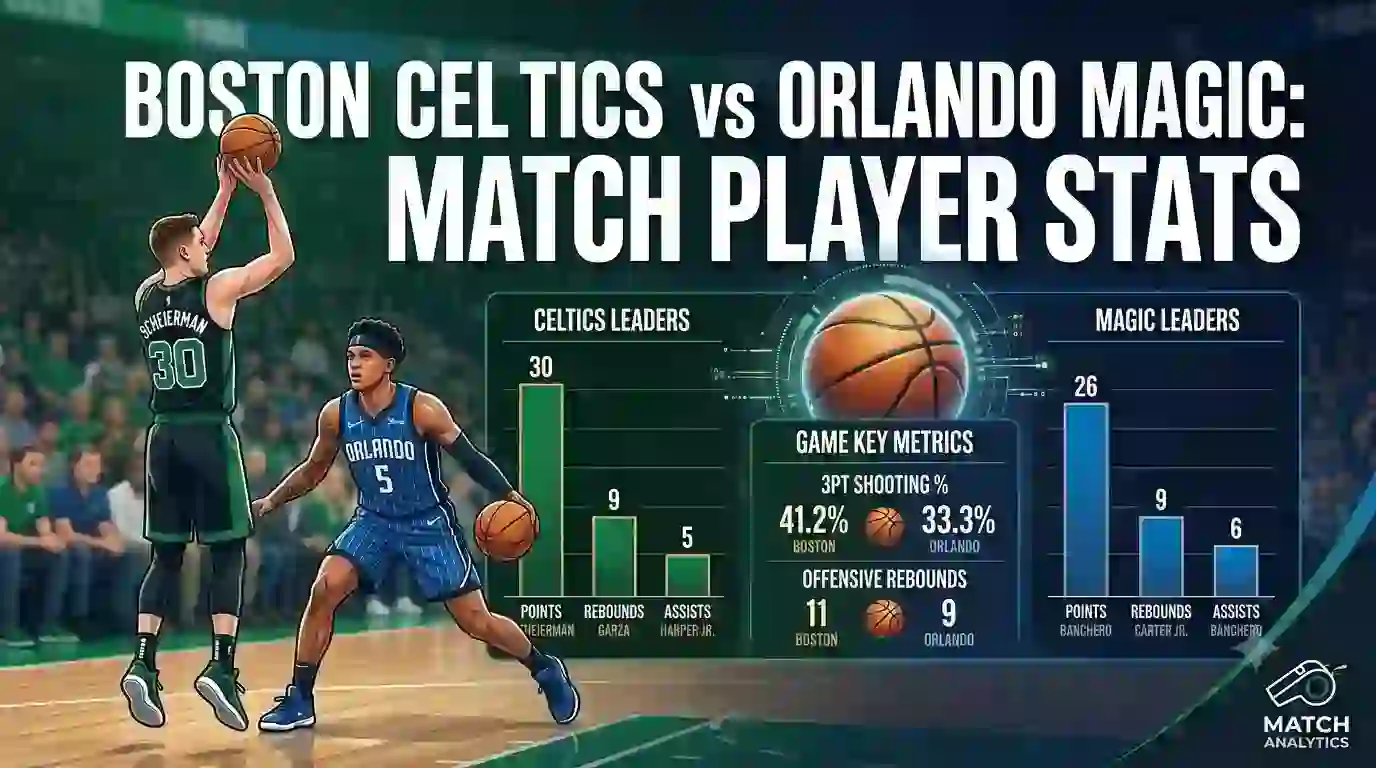
Finding verified, deep-dive box score analytics after a chaotic regular-season finale can be frustrating when most outlets only publish surface summaries. Sifting through unorganized box score figures makes it tough to analyze how Boston’s secondary lineup outexecuted Orlando’s starting starters. This detailed breakdown of the Boston Celtics vs Orlando Magic match player stats delivers exact box score metrics, period breakdowns, and tactical tracking from TD Garden.
The Boston Celtics closed out their 2025–26 regular season with an improbable 113–108 victory over the Orlando Magic on April 12, 2026, in front of a sellout crowd of 19,156 at TD Garden. Operating with eight primary players sidelined—including All-Stars Jayson Tatum and Jaylen Brown—Boston relied on immediate rotation contributions and relentless physical execution to neutralize Orlando’s playoff-bound roster.
Orlando controlled early momentum behind Paolo Banchero and Franz Wagner, but Boston erased a multi-possession deficit in the second half. Behind Baylor Scheierman’s career breakout night and Luka Garza’s late-game rim conversion, the Celtics pulled away in the final two minutes to seal a five-point victory.
2. Match Overview Table
| Information | Match Details |
| Event | 2025–26 NBA Regular Season |
| Game | Boston Celtics vs Orlando Magic |
| Date | April 12, 2026 |
| Venue | TD Garden (Boston, MA) |
| Attendance | 19,156 |
| Winner | Boston Celtics |
| Final Score | 113–108 |
| Broadcast | NBC Sports Boston, Bally Sports Florida, NBA League Pass |
3. Core Match Statistics Overview
| Metric | Boston Celtics | Orlando Magic |
| Field Goal % | 47.6% (40/84) | 45.2% (38/84) |
| 3-Point Shooting Efficiency | 41.2% (14/34) | 33.3% (11/33) |
| Free Throw % | 82.6% (19/23) | 75.0% (21/28) |
| Total Rebounds | 44 | 41 |
| Offensive Rebound Analysis | 11 | 9 |
| Assists | 26 | 22 |
| Turnovers | 12 | 14 |
| Steals | 7 | 6 |
| Blocks | 5 | 4 |
| Points in the Paint | 48 | 50 |
3-Point Shooting Efficiency
- Boston generated clean perimeter looks via high-pick-and-roll triggers, sinking 14 triples at a 41.2% clip.
- Orlando struggled from deep, converting only 33.3% of their attempts as Boston’s scramble defense restricted corner tries.
Ball Movement and Facilitation
- The Celtics recorded 26 assists on 40 made field goals, showcasing balanced ball sharing across their secondary unit.
- Orlando’s offense stalled late in possessions, resulting in 14 costly turnovers that Boston converted into 18 points.
Offensive Rebound Analysis
- Boston snatched 11 second-chance opportunities, leading directly to 15 second-chance points during crucial fourth-quarter runs.
- Orlando failed to box out on key possessions in the final four minutes, allowing Boston extra possessions down the stretch.
4. Period-by-Period Analysis
| Team | Q1 | Q2 | Q3 | Q4 | Total |
| Orlando Magic | 30 | 28 | 26 | 24 | 108 |
| Boston Celtics | 25 | 29 | 28 | 31 | 113 |
- Quarter 1: Orlando established an early interior rhythm behind Paolo Banchero’s drives, opening a 30–25 lead while Boston struggled with defensive rotations.
- Quarter 2: Boston adjusted by pushing transition tempo, trading baskets through Baylor Scheierman’s scoring to enter halftime down 58–54.
- Quarter 3: The Celtics tightened perimeter coverage, using an 8–2 run midway through the quarter to draw within two points (84–82) heading into the final frame.
- Quarter 4: Boston outscored Orlando 31–24, landing critical three-pointers and securing defensive stops in the final two minutes to clinch the win.
5. Detailed Team Player Statistics
Boston Celtics Player Statistics
| Player | MIN | PTS | REB | AST | STL | BLK | FG |
| Baylor Scheierman | 36 | 30 | 8 | 4 | 2 | 0 | 10-18 |
| Luka Garza | 28 | 18 | 9 | 2 | 1 | 2 | 7-12 |
| Ron Harper Jr. | 31 | 16 | 6 | 5 | 1 | 1 | 6-11 |
| Jordan Walsh | 29 | 12 | 7 | 3 | 2 | 1 | 5-9 |
Baylor Scheierman: Delivered a career performance with 30 points and 8 rebounds, leading Boston’s offensive engine with sharp perimeter execution. His efficiency from long range provided space for Boston’s interior plays late in the fourth quarter.
Luka Garza: Dominated inside with 18 points and 9 rebounds, including the clutch rim conversion that put Boston ahead for good with under a minute remaining. He played aggressive interior defense against Orlando’s frontcourt while establishing physical presence under the rim.
Ron Harper Jr.: Provided complete line production with 16 points, 6 rebounds, and 5 assists in a starting spot. His downhill driving created high-value open shots across all four quarters.
Jordan Walsh: Anchored Boston’s wing defense, contributing 12 points, 7 rebounds, and 2 steals. His hustle on loose balls repeatedly disrupted Orlando’s offensive sets.
Orlando Magic Player Statistics
| Player | MIN | PTS | REB | AST | STL | BLK | FG |
| Paolo Banchero | 37 | 26 | 8 | 6 | 1 | 1 | 9-20 |
| Franz Wagner | 35 | 22 | 5 | 4 | 2 | 0 | 8-17 |
| Jalen Suggs | 32 | 16 | 4 | 5 | 2 | 1 | 5-11 |
| Wendell Carter Jr. | 27 | 12 | 9 | 2 | 0 | 1 | 4-8 |
Paolo Banchero: Led Orlando with 26 points, 8 rebounds, and 6 assists, repeatedly breaching Boston’s paint defense. However, he committed four second-half turnovers under Boston’s double-team packages.
Franz Wagner: Poured in 22 points with steady mid-range shot-making. He carried Orlando’s offense in the third quarter before cooling off in the closing minutes.
Jalen Suggs: Posted 16 points and 5 assists, applying ball pressure on defense. His late-game three-point attempts missed long as Orlando chased the lead.
Wendell Carter Jr.: Controlled the glass early with 12 points and 9 rebounds. His minute load was limited down the stretch due to foul trouble.
6. Statistical Leaders Summary Table
| Category | Boston Celtics | Orlando Magic |
| Leading Scorer | Baylor Scheierman (30) | Paolo Banchero (26) |
| Second Leading Scorer | Luka Garza (18) | Franz Wagner (22) |
| Top Rebounder/Defense | Luka Garza (9) | Wendell Carter Jr. (9) |
| Most Assists/Playmaker | Ron Harper Jr. (5) | Paolo Banchero (6) |
7. Analytical Breakdowns (“Why They Won / Why They Lost”)
Why Boston Won
Balanced Bench Production and Perimeter Conversion
Boston’s secondary talent stepped up significantly, generating 42 bench points and capitalizing on open perimeter passes.
| Metric | Boston Starters | Boston Bench |
| Points Scored | 71 | 42 |
| 3PM / 3PA | 9/20 | 5/14 |
| Rebounds | 28 | 16 |
Clutch Quarter Execution
Boston locked down defensively when it mattered most, limiting Orlando to 24 fourth-quarter points while shooting 55.6% from the floor.
| Quarter 4 Metric | Boston Celtics | Orlando Magic |
| Points | 31 | 24 |
| Field Goal % | 55.6% | 38.9% |
| Turnovers | 2 | 5 |
Why Orlando Lost
Heavy Dependence on Primary Stars
Orlando relied heavily on Banchero and Wagner for individual shot creation down the stretch, leading to predictable late-game isolations.
Defensive Rotations Breakdown
Orlando allowed 14 wide-open three-pointers and lost key track of Boston’s role players on off-ball cuts during the fourth quarter.
8. Historical Context & Advanced Insights
Season Series Breakdown
| Date | Location | Winner | Score | High Scorer |
| Nov 7, 2025 | Kia Center | Orlando Magic | 123–110 | Paolo Banchero (28) |
| Nov 9, 2025 | Kia Center | Boston Celtics | 111–107 | Jayson Tatum (31) |
| Nov 23, 2025 | TD Garden | Boston Celtics | 138–129 | Jaylen Brown (34) |
| Apr 12, 2026 | TD Garden | Boston Celtics | 113–108 | Baylor Scheierman (30) |
Boston won the 2025–26 season series 3–1, demonstrating squad depth across both primary starting lineups and reserve-heavy rotational units.
Advanced Statistical Insights
Boston’s assist-to-field-goal ratio sat at 65.0%, highlighting fluid ball movement despite playing without primary playmakers. Their offensive rating reached 117.7 points per 100 possessions in this matchup, well above Orlando’s defensive season average. Meanwhile, Orlando’s true shooting percentage dropped from 58.2% in the first half to 49.1% in the second half under Boston’s physical ball containment.
9. Game Implications & Key Lessons
- What This Means for Boston:
- Demonstrates system adaptability under Joe Mazzulla, proving reserve depth can execute high-level tactical game plans.
- Builds significant confidence for developmental wings like Scheierman and Walsh heading into postseason play.
- What This Means for Orlando:
- Highlights ongoing execution struggles against aggressive, physical switching defenses in late-game scenarios.
- Emphasizes the need for consistent bench scoring contributions beyond Banchero and Wagner.
- Key Lessons:
- System execution routinely beats talent when defensive intensity is maintained across 48 minutes.
- Offensive rebound analysis shows second-chance control directly shifts late fourth-quarter momentum.
- High 3-point shooting efficiency creates necessary spacing to unlock interior scoring.
- Minimizing unforced turnovers keeps underdog teams in striking distance.
- Player performance metrics prove reserve readiness is essential for deep season runs.
Frequently Asked Questions
Who won the Boston Celtics vs Orlando Magic game on April 12, 2026?
The Boston Celtics defeated the Orlando Magic 113–108 at TD Garden.
Who was the top scorer in the Boston Celtics vs Orlando Magic game?
Boston’s Baylor Scheierman led all scorers with a career-high 30 points.
What were Paolo Banchero’s match player stats?
Paolo Banchero recorded 26 points, 8 rebounds, and 6 assists for the Orlando Magic.
Why were Jayson Tatum and Jaylen Brown missing from the box score breakdown?
Boston rested eight regular rotation players, including Tatum and Brown, to prepare for the upcoming NBA postseason.
What was the final season series record between Boston and Orlando in 2025–26?
Boston won the four-game regular season series 3–1.
Conclusion
Boston’s 113–108 victory over Orlando highlighted the supremacy of system execution and ball movement over individual star power. By dominating second-chance opportunities, knocking down timely perimeter shots, and maintaining disciplined fourth-quarter defense, the Celtics’ secondary lineup delivered an unforgettable regular-season finale performance.