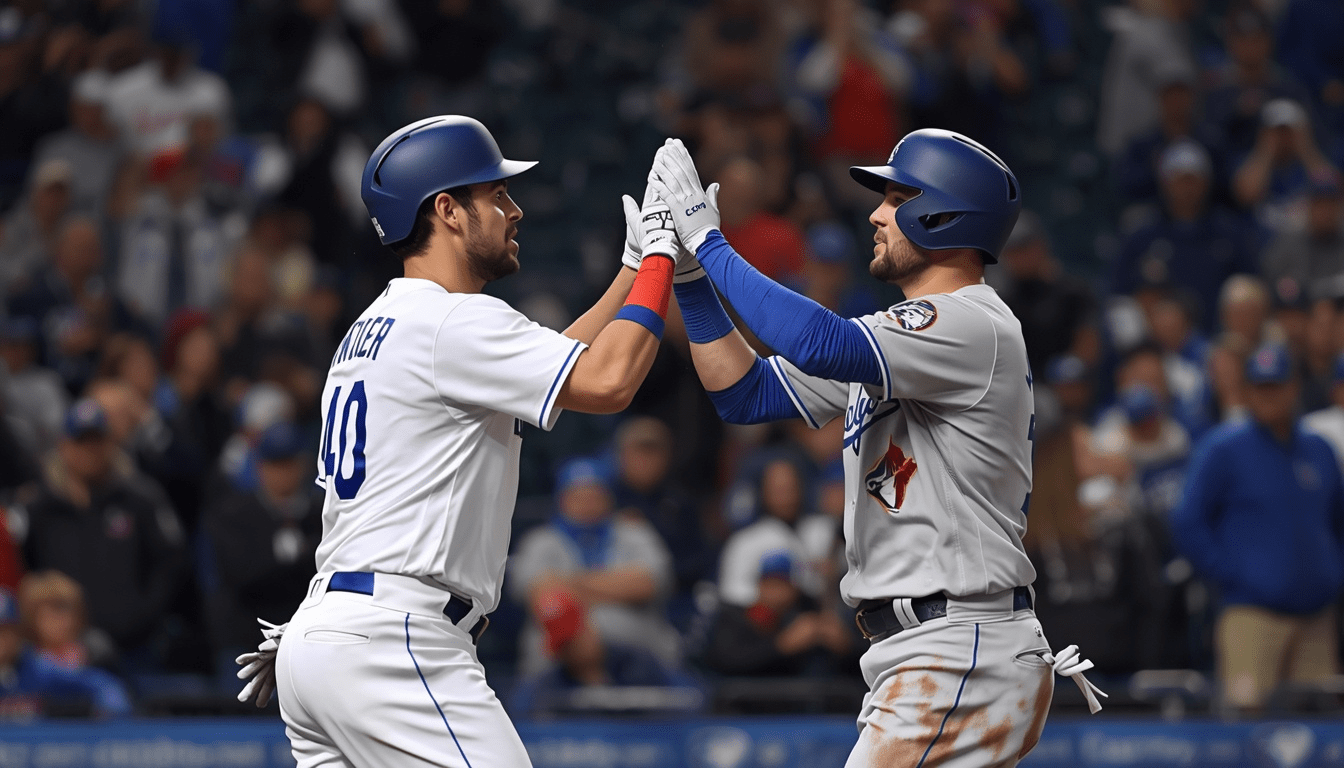
dodgers vs toronto blue jays match player stats
If you thought the 2025 World Series would be a short, tidy affair, you were dead wrong. The Dodgers and Blue Jays gave us seven games of pure, exhausting theatre. Every time one team looked ready to pull away, the other yanked them right back. By the end, the dodgers vs toronto blue jays match player stats painted a picture of two brilliant rosters separated by the thinnest of margins. Los Angeles lifted the trophy, yes, but Toronto walked off the field knowing they outhit the champions. That’s the strange, beautiful cruelty of October baseball.
Ohtani’s Week for the Ages
You can’t talk about this series without starting with Shohei Ohtani. He was the sun around which everything else orbited. Across the seven games, Ohtani posted a .333 average, crushed three home runs, drove in five runs and reached base an absurd number of times. The dodgers vs toronto blue jays match player stats show he ended with a 1.167 OPS, but even that number feels underwhelming when you recall what actually happened.
In Game 3, which lasted eighteen innings, he reached base in all nine of his plate appearances. Nine. That ties a record that had stood for decades. Blue Jays pitchers tried to nibble the corners, and he just watched balls go by. They challenged him with heat, and he turned it around. He was a nightmare dressed in Dodger blue.
Vladimir Guerrero Jr. Answers Every Punch
The thing about this series, and the dodgers vs toronto blue jays match player stats make it painfully clear, is that Vladimir Guerrero Jr. refused to be overshadowed. He hit .360, collected nine hits, smashed two home runs and scored six runs. His OPS of 1.098 would be the best number in almost any other Fall Classic. In Game 4, he hit Ohtani deep for a go-ahead two-run home run that completely changed the atmosphere at Rogers Center. Then, in Game 5, he ambushed the first pitch he saw and sent it out with Davis Schneider following right behind him. Watching Guerrero and Ohtani trade moments felt like watching two prize fighters who simply respected no one’s reputation.
Pitching That Defined the Series
For all the offensive fireworks, the dodgers vs toronto blue jays match player stats on the mound tell the real story of why the trophy went to Los Angeles. Yoshinobu Yamamoto won Games 2 and 6, threw 13.1 innings, struck out 15 and finished with a 2.03 ERA. He was cold, precise and never let a bad inning snowball. Kevin Gausman, who had been brilliant for Toronto all season, ran into a Dodgers lineup that refused to chase his splitter.
He lost both his starts and gave up crucial home runs to Max Muncy and Will Smith. Shane Bieber was the counterweight for Toronto, winning two games and striking out 19 over 17.2 innings with a 2.55 ERA. The dodgers vs toronto blue jays match player stats show Bieber was arguably the best pure pitcher in the series, but he needed just a little more help from the bats behind him.
The Marathon That Changed Everything
Game 3 will be talked about long after everyone involved has retired. Eighteen innings. Six hours and change. Both managers emptied their bullpens and then some. The dodgers vs toronto blue jays match player stats from that single night look like a misprint. Ohtani’s nine times on base. Miguel Rojas tying the game in the 14th. Tommy Edman finally ending it with a walk-off single. That game chewed up arms and legs, and the hangover spilled directly into Game 4. Toronto, fresher and sharper, capitalized immediately. But the damage to their own bullpen would haunt them later in the series.
The Unsung Disruptors
Everyone expected Ohtani, Betts and Guerrero to star. Addison Barger, who few casual fans had circled before the series, hit a grand slam off Blake Snell in Game 1 and finished with a .333 average, two homers and six RBIs. Bo Bichette, who had a somewhat quiet series until Game 7, launched a three-run homer in the first inning of the deciding game that nearly blew the roof off Rogers Centre. For the Dodgers, Max Muncy hit massive home runs in Games 2 and 7, and Miguel Rojas, a glove-first infielder, smashed a game-tying ninth-inning homer in Game 7. Those are the swings that turn series around.
The Defensive Moments No One Forgets
The dodgers vs toronto blue jays match player stats often fail to capture the glove work, but anyone who watched knows the defence decided rallies. Vladimir Guerrero Jr. made a diving stop to his right in the 10th inning of Game 7, robbing Freddie Freeman of a leadoff hit that could have sparked a rally. Mookie Betts and Tommy Edman turned a double play in Game 6 with the bases loaded, a moment that felt like a dam holding.
Andrés Giménez ranged deep into the hole at second base multiple times, throwing out runners by half a step. In a series this tight, a single misplayed ball might have changed the champion. The dodgers vs toronto blue jays match player stats don’t assign wins to defence, but the players in that clubhouse know exactly how many runs were saved.
Why the Dodgers Won a Series They Were Out-Hit In
Here is the oddest truth buried in the dodgers vs toronto blue jays match player stats. Toronto hit .274 as a team with a .753 OPS. The Dodgers hit just .238 with a .712 OPS. By the purest measures, the Blue Jays had the better offensive series. So how did Los Angeles win? Timing. Dodgers hits came with runners in scoring position, in late innings, in the moments when the air felt thickest. Smith’s solo homer in the 11th inning of Game 7.
Muncy’s shot when the team trailed. Rojas tying the game when the stadium had already started to believe. The dodgers vs toronto blue jays match player stats show that Los Angeles maximized a smaller number of hits, while Toronto left far too many runners on base in Games 2, 6 and 7.
Regular Season Preview in August
Months before the World Series, these teams met for three games at Dodger Stadium. The dodgers vs toronto blue jays match player stats from that weekend revealed a lot. Mookie Betts homered off Max Scherzer in the opener. Ohtani and Muncy went deep in Game 2. Toronto stole the finale with late-inning power. Every game was close, every pitch competitive. When they reconvened in October, there were no secrets. They knew each other’s tendencies, weaknesses and strengths. That familiarity is precisely why the series became a knife fight rather than a coronation.
A Rivalry That Has Just Begun
The dodgers vs toronto blue jays match player stats from 2025 will be referenced for years because this feels like the start of something, not the end. Both teams are built around young, prime-aged superstars. Both have deep pockets and aggressive front offices. Ohtani and Guerrero are entering their peak. Yamamoto and Bieber are in their primes. The Blue Jays tasted how close they came, and that kind of hurt lingers and motivates.
Los Angeles celebrated back-to-back titles, but they know they escaped. When you look at the dodgers vs toronto blue jays match player stats honestly, Toronto can make a compelling case that they were the better team for long stretches. That gap, so painfully narrow, is what will drive the next chapter of this rivalry. If they meet again next October, nobody should be surprised.