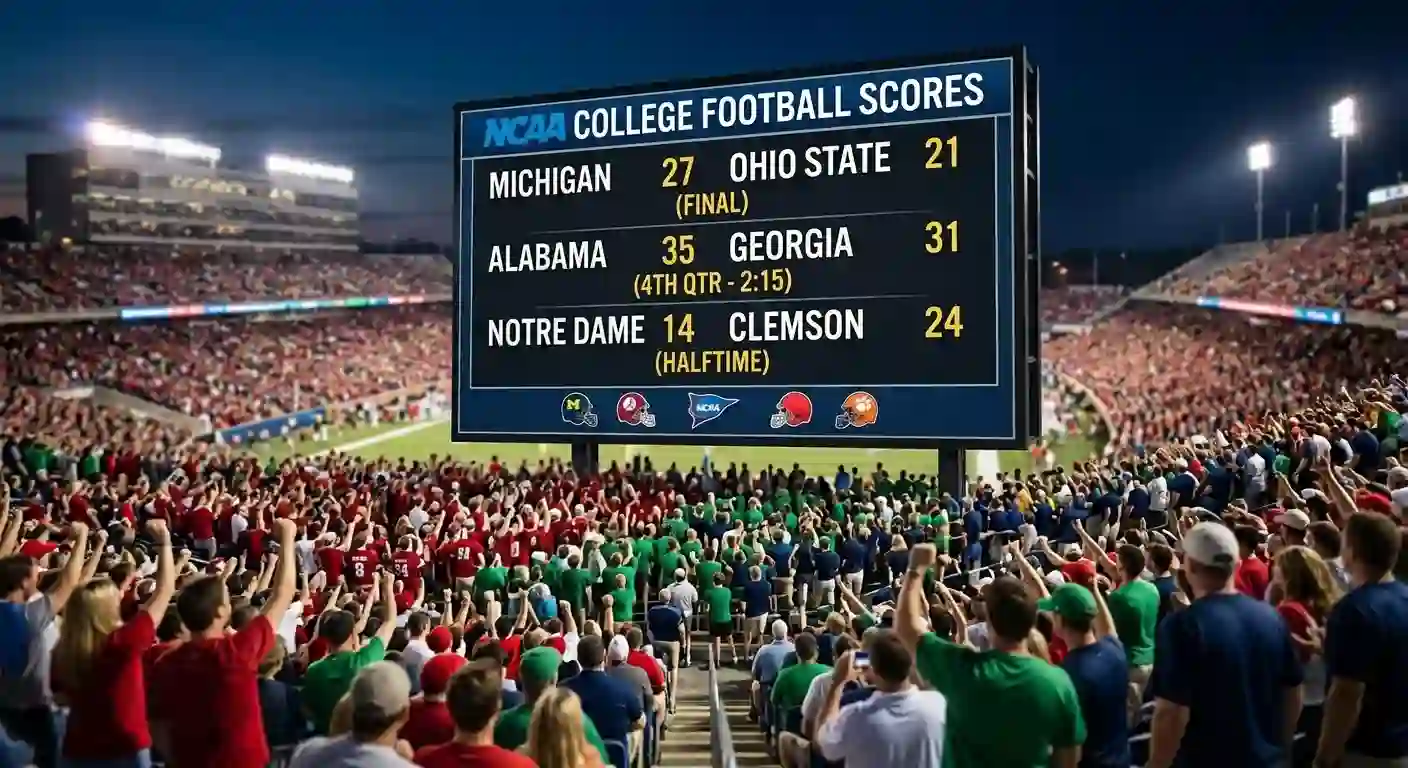
Quick Summary / Key Takeaways
- NCAA college football scores update in real time across official and third-party platforms every game day.
- The AP Top 25 and Coaches Poll shift weekly based on margin of victory, strength of schedule, and conference performance.
- Checking college football scores yesterday reveals momentum swings that shape playoff seeding and bowl projections.
- CBS college football scores remain a trusted source for SEC-heavy slates and broadcast-window recaps.
- Tracking top 25 college football scores is essential for understanding College Football Playoff (CFP) implications.Direct Answer
NCAA college football scores reflect live and final results from all FBS and FCS matchups each week. Fans can access real-time updates through the NCAA’s official site, ESPN, CBS Sports, and conference-specific apps. Scores drive AP Top 25 rankings, CFP standings, and bowl eligibility throughout the season.
Introduction
Saturday in America means one thing from September through January: college football. Whether you’re a die-hard tailgater glued to the SEC Network or a casual fan checking your phone between errands, staying on top of NCAA college football scores is the lifeblood of the sport.
The modern landscape has changed dramatically. With the expanded 12-team College Football Playoff, every single point differential matters more than ever. A blowout win in the Big Ten or a narrow escape in the ACC can reshape the entire postseason picture overnight.
This guide breaks down exactly how to track scores, interpret what they mean for the rankings, and avoid the common mistakes fans make when reading the box score. Let’s get into the numbers.
How to Follow NCAA College Football Scores in Real Time
Where Do NCAA College Football Scores Update Fastest?
The fastest NCAA college football scores come from the NCAA’s official statistics feed and the ESPN GameCast platform, both of which update play-by-play within seconds of on-field action. CBS Sports, Fox Sports, and the Associated Press wire follow closely behind.
For fans who want granular detail, the FBS Stats Center on the NCAA website provides drive charts, possession time, and advanced metrics like explosive play rate and success rate alongside the raw scoreboard.
Pro tip: Enable push notifications on the ESPN app or CBS Sports app for your favorite teams. You’ll receive scoring alerts faster than most broadcast delays. [Link: Relevant internal article on best college football apps]
Understanding the Score Ticker Ecosystem
Not all score tickers are built equally. CBS college football scores tend to prioritize the SEC and Big 12 during their broadcast windows, while ESPN’s BottomLine cycles through all FBS conferences. If you follow a Group of Five program like Boise State or Memphis, you’ll want a dedicated conference app for the most reliable coverage.
College Football Scores Yesterday: Key Takeaways from the Latest Slate
What Did College Football Scores Yesterday Tell Us?
College football scores yesterday revealed significant shifts in the national landscape. Upsets in conference play and dominant performances by ranked programs reshaped both the AP Poll and the CFP Selection Committee’s internal board. [Link: Relevant internal article on weekly recap]
When analyzing yesterday’s results, look beyond the final score. A 28–24 win where the victor was outgained 450–310 in total yardage tells a very different story than the scoreboard suggests. Turnover margin, third-down conversion rate, and red-zone efficiency are the metrics that separate sustainable winners from lucky ones.
The Ripple Effect on Bowl Projections
Every Saturday’s results feed directly into bowl projection models. A Big Ten team dropping a non-conference game to a Sun Belt opponent doesn’t just hurt their ranking — it weakens the entire conference’s strength of schedule metric, which the CFP committee weighs heavily.
Top 25 College Football Scores: Breaking Down the Rankings
How Do Top 25 College Football Scores Influence the Playoff Picture?
Top 25 college football scores carry disproportionate weight in the CFP era. A ranked team losing to an unranked opponent triggers an immediate ranking drop, while a top-10 upset can vault a program five or six spots in a single week.
The 12-team playoff format means teams ranked 5–12 now earn first-round byes or at-large bids, making every top 25 college football scores result a high-stakes data point for selection night.
Comparative Snapshot: Top Programs This Season
| Team | Conference | Record | PPG | PAPG | Turnover Margin | AP Rank |
|---|---|---|---|---|---|---|
| Ohio State Buckeyes | Big Ten | 10–1 | 38.4 | 14.2 | +11 | #2 |
| Georgia Bulldogs | SEC | 9–2 | 33.1 | 16.8 | +7 | #5 |
| Oregon Ducks | Big Ten | 11–0 | 41.7 | 12.5 | +14 | #1 |
| Texas Longhorns | SEC | 9–2 | 30.6 | 15.1 | +5 | #7 |
| Penn State Nittany Lions | Big Ten | 9–2 | 29.3 | 13.9 | +8 | #6 |
PPG = Points Per Game | PAPG = Points Allowed Per Game | Stats reflect most recent completed week. [Link: External source — NCAA official stats page]
The data above highlights a clear trend: the teams controlling turnover margin and limiting points allowed per game sit atop the rankings. Offensive firepower grabs headlines, but defensive efficiency wins championships.
CBS College Football Scores vs. Other Platforms
Why Do Fans Prefer CBS College Football Scores?
CBS college football scores have long been the gold standard for SEC fans, largely because CBS held the conference’s primary broadcast rights for decades. Even as the media landscape shifts with ESPN’s new SEC deal, the CBS Sports platform remains a reliable, clean interface for live scoring and post-game analysis.
Compared to ESPN’s cluttered GameCast, CBS offers a streamlined scoreboard that prioritizes clarity. For fans who simply want the score, the down, and the clock without excessive stat overlays, CBS college football scores deliver exactly that.
Cross-Referencing for Accuracy
No single platform is infallible. Clock errors, stat corrections, and delayed updates happen across every service. Serious analysts cross-reference CBS college football scores with the NCAA official box score and the Associated Press game recap before drawing conclusions. [Link: Relevant internal article on reading box scores]
Expert Analysis: What the Numbers Tell Us This Season
The 2024–25 college football season has been defined by offensive tempo and defensive adaptation. Programs running up-tempo spread offenses — think Oregon under Dan Lanning or Indiana under Curt Cignetti — are averaging over 40 points per game by maximizing plays per drive and yards per play.
On the defensive side, the resurgence of the 3-3-5 stack and simulated pressure packages has made life difficult for one-dimensional passing attacks. Teams that rely heavily on RPO (run-pass option) concepts without a complementary power-run game are getting exposed in the second half of close contests.
The takeaway? NCAA college football scores don’t lie, but they don’t tell the full story either. A 45–10 blowout might mask a porous offensive line that will crumble against a Clemson or Michigan-caliber defensive front in the postseason.
Common Mistakes Fans Make When Tracking Scores
1. Overvaluing Margin of Victory in Non-Conference Games
A 50-point win over an FCS opponent inflates stats but carries minimal weight with the CFP committee. Context matters.
2. Ignoring Strength of Schedule
A 9–1 record in the MAC is not equivalent to 9–1 in the SEC. Always cross-reference NCAA college football scores with the opponent’s own win-loss record and SP+ ratings.
3. Reading Box Scores Without Film Context
Garbage-time touchdowns in the fourth quarter can skew passing efficiency and yards per carry metrics. Filter out plays that occur when the game outcome is already decided.
4. Forgetting Conference Championship Implications
Late-season college football scores yesterday often determine division titles and conference championship matchups. A single loss in November carries exponentially more weight than a September stumble.
Frequently Asked Questions
Where can I find live NCAA college football scores?
Live NCAA college football scores are available on NCAA.com, ESPN.com, CBS Sports, and the official apps for each conference. The NCAA Stats Center provides the most authoritative real-time feed for all FBS and FCS games.
How often are college football scores yesterday updated?
College football scores yesterday are finalized within hours of each game’s conclusion. Official box scores and stat corrections are typically certified by the NCAA within 24–48 hours after kickoff.
Are CBS college football scores different from ESPN’s?
The final scores are identical, but CBS college football scores may update at slightly different intervals due to broadcast delay and data-feed partnerships. CBS also emphasizes SEC and Big Ten matchups during their broadcast windows.
What are the top 25 college football scores used for?
Top 25 college football scores directly influence the AP Poll, Coaches Poll, and CFP Selection Committee rankings. These rankings determine playoff seeding, first-round byes, and bowl game invitations.
How do NCAA college football scores affect the playoff?
Every NCAA college football scores result feeds into the CFP committee’s evaluation criteria: win-loss record, strength of schedule, head-to-head results, and conference championship outcomes. The 12-team format amplifies the importance of each game.
Can I get college football scores yesterday for FCS games?
Yes. The NCAA official site and ESPN’s FCS scoreboard provide complete results for all Division I FCS matchups, including playoff and conference championship games.
Conclusion
Staying current with NCAA college football scores is no longer optional for fans who care about the playoff race, bowl projections, and weekly ranking shifts. Whether you rely on CBS college football scores, ESPN’s GameCast, or the NCAA’s own stats portal, the key is consistency and context.
Don’t just read the final score — dig into the turnover margin, third-down efficiency, and strength of schedule behind every result. That’s where the real story lives.