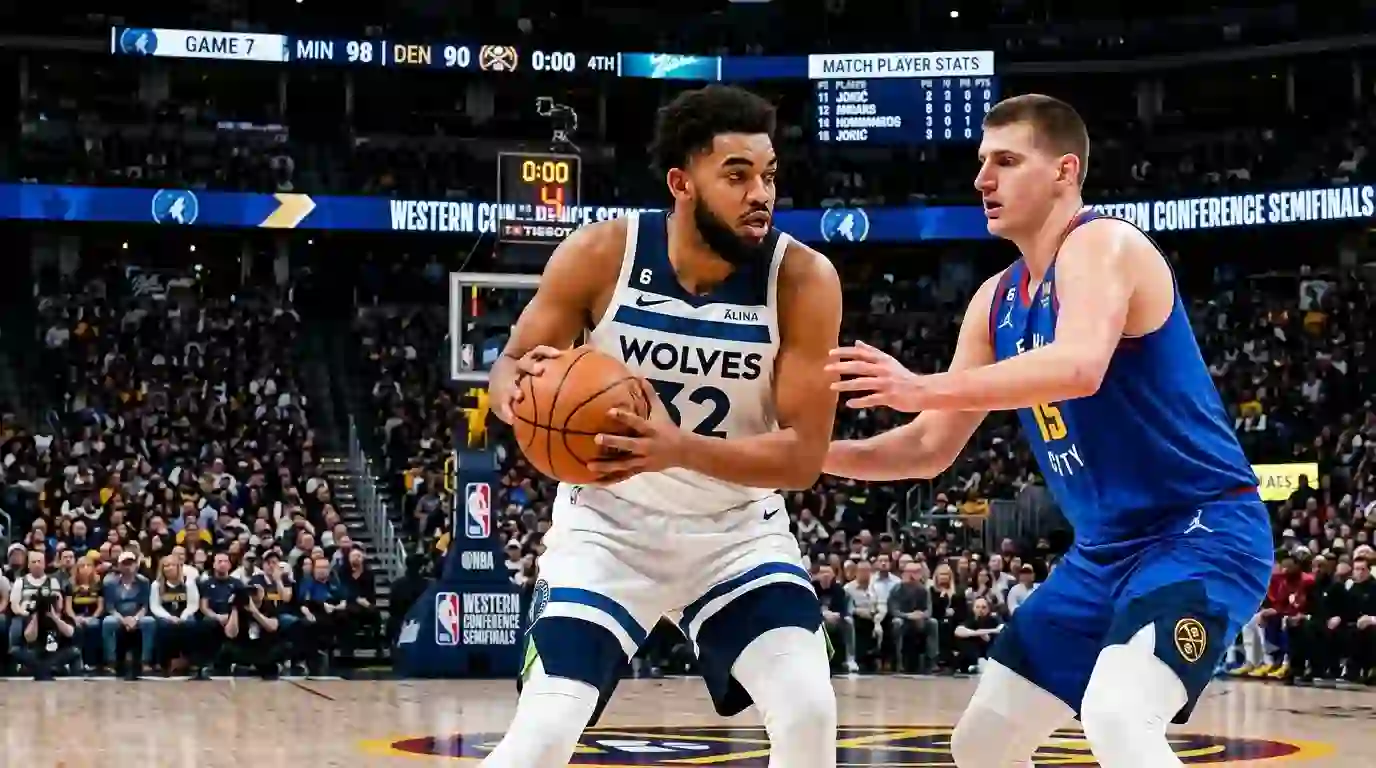
Finding actionable insights from a high-stakes NBA playoff box score often gets buried under surface-level summaries. Fans and analysts struggle to pinpoint which specific rotational adjustments and efficiency gaps dictated the game’s final outcome. This deep-dive timberwolves vs denver nuggets match player stats breakdown cuts through basic scoring figures to reveal the defensive ratings, rebounding margins, and second-half shooting percentages that decided Game 7.
On May 19, 2024, the Minnesota Timberwolves traveled to Ball Arena in Denver, Colorado, facing a 20-point second-half deficit in front of a sold-out crowd of 19,980 fans. What unfolded was the largest Game 7 comeback in NBA playoff history. Minnesota locked down Denver’s high-powered offense in the final two quarters, outscoring the reigning champions 60-37 after halftime to secure a 98-90 victory and advance to the Western Conference Finals.
The contest turned on interior defense, key offensive rebounds, and timely secondary scoring. While Anthony Edwards struggled early from the field, Karl-Anthony Towns and Jaden McDaniels delivered elite two-way production. Denver relied almost exclusively on Nikola Jokić and Jamal Murray, but a lack of bench production and fatigue ultimately derailed their defense of the title.
Match Overview Table
| Information | Match Details |
| Event | 2024 NBA Playoffs (Western Conference Semifinals Game 7) |
| Game | Minnesota Timberwolves vs. Denver Nuggets |
| Date | May 19, 2024 |
| Venue | Ball Arena (Denver, CO) |
| Attendance | 19,980 |
| Winner | Minnesota Timberwolves |
| Final Score | 98 – 90 |
| Broadcast | TNT, Max, Live Sports Streaming |
Core Match Statistics Overview
| Metric | Minnesota Timberwolves | Denver Nuggets |
| Field Goals Made-Attempted | 31-79 (39.2%) | 33-80 (41.3%) |
| 3-Point Field Goals | 10-34 (29.4%) | 8-33 (24.2%) |
| Free Throws Made-Attempted | 26-30 (86.7%) | 16-22 (72.7%) |
| Total Rebounds | 47 | 44 |
| Offensive Rebounds | 11 | 9 |
| Assists | 18 | 19 |
| Turnovers | 9 | 10 |
| Steals | 9 | 5 |
| Blocks | 6 | 4 |
| Personal Fouls | 21 | 22 |
Three-Point Shooting
- Minnesota made 10 perimeter shots compared to Denver’s 8, converting critical back-to-back triples during their 18-4 third-quarter run.
- Denver suffered from severe perimeter regression, hitting just 24.2% of their attempts beyond the arc.
Free Throw Scoring Efficiency
- The Timberwolves capitalized at the charity stripe, connecting on 26 of 30 attempts (86.7%) to build a +10 scoring margin at the line.
- Denver left 6 points on the floor with a 72.7% free-throw rate, failing to draw late fouls during Minnesota’s fourth-quarter push.
Ball Movement & Ball Security
- Minnesota protected the basketball with precision, recording a clean assist-to-turnover ratio by committing only 9 giveaways.
- Denver logged 19 assists but generated only 5 steals, failing to create easy transition chances in the second half.
Period-by-Period Analysis
Quarter 1
| Team | Score |
| Minnesota Timberwolves | 19 |
| Denver Nuggets | 24 |
- Jamal Murray opened hot with 13 early points, taking advantage of drop-coverage screens.
- Minnesota’s offense stalled due to 8-for-22 shooting from the field, missing 6 of their 8 three-point attempts.
- Karl-Anthony Towns kept Minnesota within reach by converting inside and drawing two early fouls on Denver’s frontcourt.
Quarter 2
| Team | Score |
| Minnesota Timberwolves | 19 |
| Denver Nuggets | 29 |
- Denver executed a dominant 16-0 scoring run, pushing their lead to 15 points late in the quarter.
- Nikola Jokić dictated tempo in the post, collecting 8 rebounds and controlling defensive possessions.
- Anthony Edwards sat extended minutes after picking up his second foul, leaving Minnesota without primary rim pressure.
Quarter 3
| Team | Score |
| Minnesota Timberwolves | 28 |
| Denver Nuggets | 14 |
- Minnesota opened the quarter on a decisive 18-4 scoring burst, cutting a 20-point deficit down to 4 points.
- Jaden McDaniels sparked the defense with 2 steals and a block, holding Denver to just 14 total quarter points.
- Edwards shifted into playmaking mode, delivering 4 assists in the frame to set up Towns and Mike Conley.
Quarter 4
| Team | Score |
| Minnesota Timberwolves | 32 |
| Denver Nuggets | 23 |
- Naz Reid stepped up off the bench, scoring 8 points and snatching critical offensive rebounds in the final 8 minutes.
- Denver’s starters ran out of gas, converting just 2 of 10 field goals over the final six minutes of regulation.
- Minnesota sealed the win by shooting 11-of-12 from the free-throw line down the stretch.
Detailed Team Player Statistics
Minnesota Timberwolves Player Statistics
| Player | MP | PTS | REB | AST | STL | BLK | FG |
| Karl-Anthony Towns | 39:08 | 23 | 12 | 2 | 2 | 1 | 8-14 |
| Jaden McDaniels | 39:42 | 23 | 6 | 1 | 2 | 1 | 7-10 |
| Anthony Edwards | 43:47 | 16 | 8 | 7 | 2 | 0 | 6-24 |
| Rudy Gobert | 35:37 | 13 | 9 | 1 | 1 | 2 | 3-7 |
| Naz Reid | 21:55 | 11 | 4 | 1 | 0 | 2 | 4-7 |
- Karl-Anthony Towns: Towns anchored Minnesota’s frontcourt efficiency with 23 points and 12 rebounds on 57.1% shooting. His interior scoring during the third quarter stabilized the offense while Edwards worked through early perimeter struggles.
- Jaden McDaniels: McDaniels provided two-way energy, scoring 23 points while converting 3-of-4 shots from beyond the arc. His primary ball-pressure on Murray forced critical second-half turnovers.
- Anthony Edwards: Edwards battled through a 6-for-24 shooting night but impacted the box score with 8 rebounds, 7 assists, and 2 steals. His passing in the fourth quarter repeatedly set up open looks for Minnesota’s baseline cutters.
- Naz Reid: Operating as the key bench contributor, Reid contributed 11 points, 4 rebounds, and 2 timely blocks in just 22 minutes. His putback dunk in the fourth quarter gave Minnesota its first lead since the opening period.
Denver Nuggets Player Statistics
| Player | MP | PTS | REB | AST | STL | BLK | FG |
| Nikola Jokić | 46:38 | 34 | 19 | 7 | 0 | 1 | 13-28 |
| Jamal Murray | 43:10 | 35 | 3 | 3 | 1 | 0 | 13-27 |
| Christian Braun | 25:31 | 5 | 3 | 2 | 2 | 0 | 2-4 |
| Aaron Gordon | 41:40 | 4 | 4 | 2 | 1 | 1 | 2-5 |
| Michael Porter Jr. | 33:53 | 7 | 9 | 0 | 1 | 2 | 3-12 |
- Nikola Jokić: Jokić put together a monster individual line of 34 points, 19 rebounds, and 7 assists across 46 minutes. However, constant double-teams in the fourth quarter wore him down, resulting in 2-for-10 shooting from distance.
- Jamal Murray: Murray generated 35 points on 13-of-27 shooting, powering Denver’s early 20-point advantage. His efficiency dropped in the fourth quarter as Minnesota’s length contested his off-dribble jumper.
- Aaron Gordon: Gordon spent most of his night defending Towns and Gobert, finishing with 4 points and 4 rebounds. His offensive volume was limited as Minnesota packed the paint.
- Michael Porter Jr.: Porter Jr. struggled to find rhythm, converting just 3 of 12 field goals for 7 points. His inability to break through Minnesota’s perimeter length hampered Denver’s floor spacing.
Statistical Leaders Summary Table
| Category | Minnesota Timberwolves | Denver Nuggets |
| Leading Scorer | Karl-Anthony Towns (23) / Jaden McDaniels (23) | Jamal Murray (35) |
| Second Leading Scorer | Anthony Edwards (16) | Nikola Jokić (34) |
| Top Rebounder/Defense | Karl-Anthony Towns (12) | Nikola Jokić (19) |
| Most Assists/Playmaker | Anthony Edwards (7) | Nikola Jokić (7) |
Analytical Breakdowns (“Why They Won / Why They Lost”)
Why Minnesota Won
Frontcourt Scoring Efficiency & Rebounding
Minnesota’s twin-tower pairing of Karl-Anthony Towns and Rudy Gobert controlled interior spaces during the second half. Towns scored 23 points on 57.1% shooting while Gobert added 13 points and 9 rebounds.
| Player | Points | Rebounds | FG% |
| Karl-Anthony Towns | 23 | 12 | 57.1% |
| Rudy Gobert | 13 | 9 | 42.9% |
Clutch Bench Production
Minnesota received high-impact minutes from Naz Reid, whose late-game energy shifted total bench scoring heavily in favor of the Timberwolves.
| Bench Group | Points | Rebounds | Blocks |
| Minnesota Bench | 13 | 4 | 2 |
| Denver Bench | 5 | 9 | 0 |
Defensive Adjustments on Perimeter Drivers
After allowing 53 first-half points, Minnesota switched all high pick-and-rolls, holding Denver to 37 total points across the 3rd and 4th quarters combined.
Why Denver Lost
Heavy Dependence on Two Players
Jokić and Murray combined for 69 of Denver’s 90 points (76.6%). The remaining six Nuggets players who saw court time managed just 21 total points.
Late-Game Fatigue & Defensive Ratings Slump
Playing four starters over 33 minutes each drained Denver’s stamina. The Nuggets registered an abysmal 37.8% field goal mark in the fourth quarter while surrendering 32 points.
Historical Context & Advanced Insights
Season Series Breakdown
| Date | Matchup | Location | Result | Top Scorer |
| Nov 1, 2023 | DEN vs MIN | Minneapolis | MIN 110 – 89 | Anthony Edwards (24) |
| Mar 19, 2024 | DEN vs MIN | Minneapolis | DEN 115 – 112 | Nikola Jokić (35) |
| Mar 29, 2024 | MIN vs DEN | Denver | MIN 111 – 98 | Anthony Edwards (25) |
| Apr 10, 2024 | MIN vs DEN | Denver | DEN 116 – 107 | Nikola Jokić (41) |
| May 19, 2024 | MIN vs DEN (G7) | Denver | MIN 98 – 90 | Jamal Murray (35) |
Advanced Statistical Insights
Analyzing the true shooting percentages and possessional efficiency reveals why Minnesota prevailed despite Anthony Edwards shooting 25.0%. Minnesota maintained a stellar 58.1% Assist-to-Field-Goal ratio on 31 made baskets. Furthermore, Minnesota generated 1.18 points per possession in the second half compared to Denver’s 0.82. By attacking the glass and earning 30 free-throw attempts, the Timberwolves offset their poor early jump-shooting with elite floor spacing and secondary movement.
Game Implications & Key Lessons
What This Means for Minnesota
- Championship Legitimacy: Overcoming a 20-point road deficit against the defending champions proves Minnesota’s roster structure can handle intense playoff adversity.
- Frontcourt Validation: The Towns-Gobert combination silenced critics by dominating the glass and slowing down Jokić down the stretch.
What This Means for Denver
- Bench Depth Urgency: Denver’s lack of second-unit scoring forces the front office to prioritize rotation depth during the off-season.
- Starter Overload: Heavy starter minutes throughout the regular season and playoffs left Denver depleted during second-half clutch minutes.
Key Lessons
- Defensive ratings in the half-court win high-stakes Game 7 matchups.
- Star players must impact the game through rebounds and assists when shots fall short.
- Scoring efficiency at the free-throw line creates a safe floor during dry shooting spells.
- Offensive rebounds late in fourth quarters disrupt an opponent’s transition game.
- Team depth and balanced scoring outweigh top-heavy offensive schemes over a grueling seven-game series.
Frequently Asked Questions
Who won the Timberwolves vs Denver Nuggets Game 7 matchup?
The Minnesota Timberwolves won Game 7 by a final score of 98-90, completing a 20-point second-half comeback at Ball Arena.
Who was the top scorer in the timberwolves vs denver nuggets match player stats?
Jamal Murray led all scorers with 35 points for Denver. Karl-Anthony Towns and Jaden McDaniels co-led Minnesota with 23 points each.
What were Anthony Edwards’ final player stats in Game 7?
Anthony Edwards recorded 16 points, 8 rebounds, 7 assists, and 2 steals while playing nearly 44 minutes.
How many points did Nikola Jokić score in the game?
Nikola Jokić scored 34 points alongside 19 rebounds and 7 assists across 46 minutes of play.
What was the key stat that decided the second half?
Minnesota outscored Denver 60-37 in the second half while holding the Nuggets to 24.2% shooting from three-point range.
Conclusion
The statistical landscape of Game 7 highlights how defensive execution, bench depth, and board control overcome single-game shooting slumps. Minnesota relied on balanced contributions across their entire main rotation. Denver’s top-heavy production ran out of momentum when shot-making faded in the fourth quarter, allowing Minnesota to claim a historic postseason victory.